

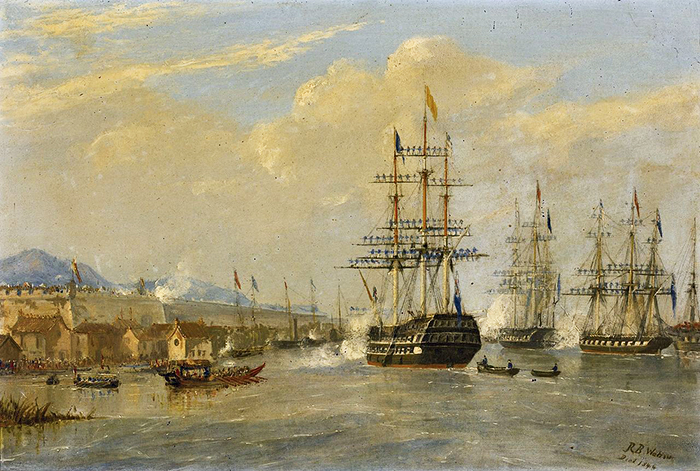
The End of the First Opium War

29th August 1842

On this day, The Treaty of Nanking was signed, putting and end to the First Opium War (1839-1842) between Great Britain and the Qing dynasty of China. The war was sparked by China’s decision to stop the illegal importation of opium from British plantations in India and the successive destruction of a huge quantity of British opium at Humen by the Chinese Imperial Commissioner Lin Zexu. Britain’s use of recently invented military technology produced a crushing victory and allowed it to impose a one-sided treaty requiring the Chinese to pay a huge indemnity, to cede the island of Hong Kong to the British as a colony, and to allow trade at five ‘treaty ports’. The treaty was signed by British and Chinese officials on board HMS Cornwallis anchored in the Yangtze river at Nanking. It was the first of what the Chinese later termed the ‘unequal treaties’.

Puoi trovare altre brevi notizie storiche QUI


Your comments are always very welcome.


The March on Washington for Jobs and Freedom

28th August 1963

On this day, more than 2,000 buses, 21 chartered trains, 10 chartered airliners, and uncounted cars converged on Washington to take part in the March on Washington for Jobs and Freedom. Approximately 250,000 people, mostly African Americans, marched from the Washington Monument to the Lincoln Memorial to advocate for the civil and economic rights of African Americans. The march was organized by Bayard Rustin and A. Philip Randolph, who built an alliance of civil rights, labour, and religious organisations that came together under the banner of ‘jobs and freedom’. The most notable speech that day came from the final speaker, Dr. Martin Luther King Jr. Standing in front of the Lincoln Memorial, he delivered his historic “I Have a Dream” speech in which he called for an end to legalised racism and racial segregation. The march is credited with helping to pass the Civil Rights Act of 1964.

Read and listen
to Martin Luther King’s speech
HERE

Puoi trovare altre brevi notizie storiche QUI


Your comments are always very welcome.