
Attila the Hun Invades Italy

8th June 452

On this day, Attila, the infamous leader of the Huns, led his armies into Italy, intent on taking Rome, the historic centre of the tottering Roman Empire in western Europe. Attila’s armies had already looted and pillaged across eastern Europe but had failed to breach the defences of Constantinople. They had then been seriously defeated in France. Notwithstanding his heavy losses, Attila managed to raise a new army in just a year and headed into a poorly-defended Italy. His advancement was stopped only by the intervention of Pope Leo I who travelled north from Rome and met Attila on horseback in the middle of a river near the modern city of Mantua in northern Italy. It is not known what was said at the meeting, but Attila retreated from Italy after the meeting and died the following year on his wedding night.

Puoi trovare altre brevi notizie storiche QUI


Your comments are always very welcome.
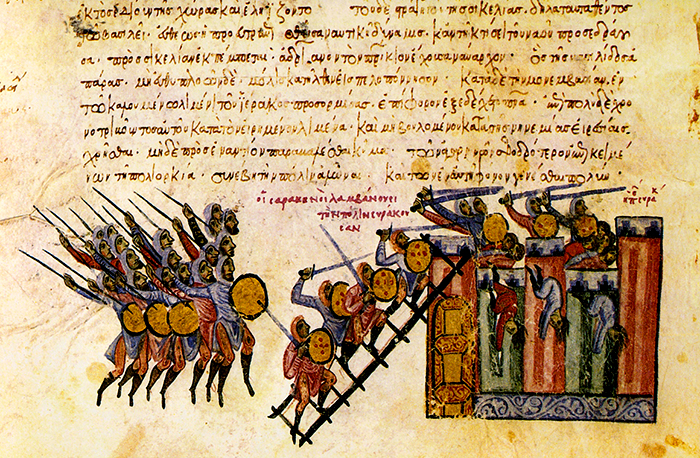

The Aghlabid Siege of Syracuse

21st May 878

On this day, the city of Syracuse, the Byzantine capital of Sicily, fell to the Aghlabid forces after a siege lasting 10 months. The Aghlabids had tried several times without success to capture Syracuse since their arrival in Western Sicily in the 820s and the new governor Ja’far ibn Muhammad was determined to change their fortunes. The inhabitants of Syracuse, unsupported by the Byzantine fleet which was busy transporting marble for a new church in Constantinople, had to face great hardships and famine. When the Aghlabids finally managed to make a breach in the seaward walls and to break through it into the city, the defenders either fell in battle or were taken prisoner. With the capture of Taormina in 902, the Muslim conquest of Sicily was effectively complete.

Puoi trovare altre brevi notizie storiche QUI


Your comments are always very welcome.


Byzantium Renamed Constantinople

11th May 330

On this day, the ancient city of Byzantium, already serving as the new capital of the Roman Empire under the name of Nova Roma, was renamed Constantinople and dedicated to the Emperor Constantine. Generally considered to be the centre and the ‘cradle of Orthodox Christian civilisation’, from the mid-5th century to the early 13th century, Constantinople was the largest and wealthiest city in Europe. The city was not only famous for its architectural masterpieces, but also for its massive and complex fortifications which proved impenetrable until the armies of the Fourth Crusade devastated the city in 1204. In the early 20th century, the city came under Turkish rule and on 28th March 1930 was officially renamed as Istanbul.

Puoi trovare altre brevi notizie storiche QUI


Your comments are always very welcome.