
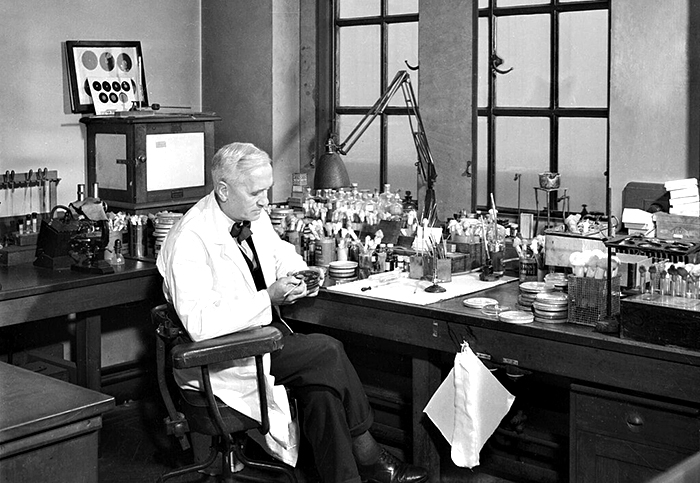
On this day, the Scottish physician and microbiologist, Alexander Fleming, discovered the world’s first broadly effective antibiotic substance, which he later named penicillin. His discovery has been described as the “single greatest victory ever achieved over disease” and led to him sharing the Nobel Prize in Physiology or Medicine in 1945 with Howard Florey and Ernst Chain. Earlier, in 1944, he received a knighthood for his scientific achievements and in 1999 he was named in Time magazine’s list of the 100 Most Important People of the 20th century. In his memoirs he says, “When I woke up just after dawn on September 28, 1928, I certainly didn’t plan to revolutionise all medicine by discovering the world’s first antibiotic, or bacteria killer. But I suppose that was exactly what I did.”

Puoi trovare altre brevi notizie storiche QUI

Your comments are always very welcome.
 Ingliando