
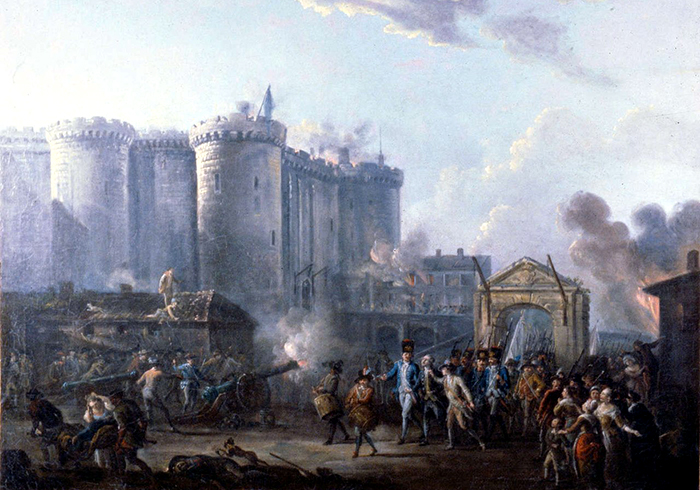
On this day in Paris, France, the medieval armoury, fortress, and political prison known as the Bastille was stormed by revolutionary insurgents. The Bastille represented royal authority in the centre of Paris and was seen by the revolutionaries as a symbol of the monarchy’s abuse of power. After four hours of fighting and 94 deaths, the insurgents managed to enter the Bastille where the governor and several members of the garrison were killed after surrendering. Two days after the storming of the Bastille the British ambassador to France is reported to have said, “Thus, my Lord, the greatest revolution ….. has been effected with, comparatively speaking, ….. the loss of very few lives. From this moment we may consider France as a free country, the King a very limited monarch, and the nobility as reduced to a level with the rest of the nation.” The fall of the Bastille is seen by many as being the flashpoint of the French Revolution.
Read Bob Lynn’s short story “The Certainties of a Doomed Man”
about the fall of the Bastille HERE
Puoi trovare altre brevi notizie storiche QUI

Your comments are always very welcome.

 Ingliando
💙🤍❤️
LikeLiked by 1 person
Allons enfants de la patrie
LikeLiked by 1 person
Have you read Bob Lynn’s story in the link? I think you would enjoy it.
LikeLiked by 1 person
Yes, I hAVE READ IT and I think that Louis XVI was the weak heir of a centuries-old dynasty which proved corrupted . The funny thing is that he was the least culpable 0f them all. Let’s consider the fact that it was not so much Marie Antoniette’s heavy debt but the expenses he incurred in supporting the 13 English colonies bye , Tony and thanks for letting us learn so much
LikeLiked by 1 person
😀👍
LikeLike