
The Cairngorm Plateau Disaster

22nd November 1971

On this day, a two-day navigational expedition in a remote area of the Cairngorms in the Scottish Highlands came to a tragic conclusion when five teenage participants and an assistant all died of exposure. On reaching the Cairngorm Plateau, the expedition split into two groups, one led by Ben Beattie and the other by Catherine Davidson, but weather conditions deteriorated very quickly and Davidson’s less experienced group, concerned that they would not find the pre-arranged Curran shelter, decided to bivouac out on the plateau. The blizzard continued to rage all through Sunday, but Beattie’s more experienced group managed to descend from the Curran shelter in the late afternoon and raise the alarm. The following morning, rescue teams eventually found Davidson, barely alive and crawling for help. With her guidance they were able to locate and dig out the bodies of the assistant and the six teenagers, only one of whom was still alive. A memorial service to the victims was held at Insh parish church on 28 November.

The Curran Shelter

Puoi trovare altre brevi notizie storiche QUI


Your comments are always very welcome.

Piltdown Man Finally Exposed

21st November 1953

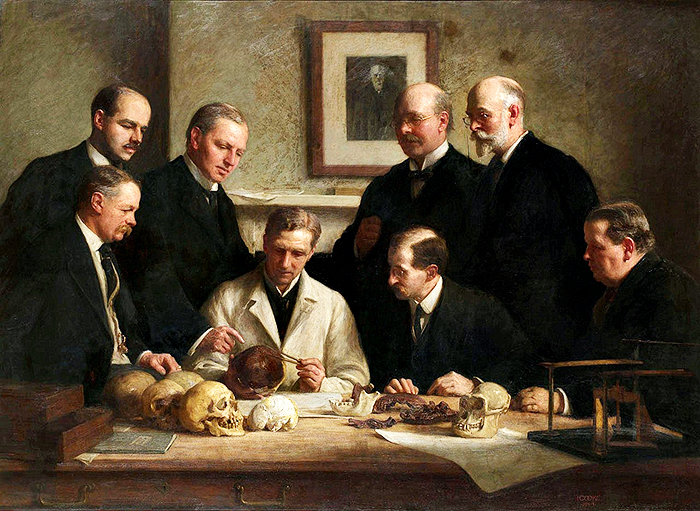
On this day, after an intensive investigation, a team of scientists announced to the world that the famous Piltdown Man was actually a hoax. In 1912, amateur archaeologist Charles Dawson announced the discovery of a skull and jawbone in Piltdown, England. The find, which was initially hailed as the missing link between apes and humans, was widely accepted by the British scientific community, which was eager to prove Britain’s part in human evolution. Over the next 40 years, however, doubts continued to grow. Eventually, in 1953, scientists used advanced dating techniques to reveal that the skull belonged to a medieval-age human, the jawbone and teeth were from a modern orangutan, the bones had been chemically stained to make them appear ancient, and the teeth had been filed down to mimic human wear. The identity of the Piltdown forger remains unknown, but Dawson, who was not new to archaeological hoaxes, remains the chief suspect.

Puoi trovare altre brevi notizie storiche QUI


Your comments are always very welcome.


The Sinking of the Whaling Ship Essex

20th November 1820

On this day, the American whaling ship Essex from Nantucket, Massachusetts, was attacked and sunk by an unusually large sperm whale bull 3,700 kilometres from the west coast of South America. The 20-man crew was forced to make for land in three whaleboats with the food and water they could salvage from the wreck. After a month at sea the crew landed on the uninhabited Henderson Island. Three men elected to stay on the island, from which they were rescued in April 1821, while the remaining seventeen set off again for the coast of South America. The men suffered severe dehydration, starvation and exposure on the open ocean, and the survivors eventually resorted to cannibalism. By the time they were rescued in February 1821, three months after the sinking of Essex, only five of the seventeen were alive. The tragedy attracted international attention, and inspired Herman Melville to write his 1851 novel, Moby Dick.

Puoi trovare altre brevi notizie storiche QUI


Your comments are always very welcome.


O Milésimo – Pelé’s Thousandth Goal

19th November 1969

On this day, the Brazilian footballer, Edson Arantes do Nascimento, better known by his nickname Pelé, scored his 1000th goal, dubbed O Milésimo (The Thousandth), in a match between his team Santos FC and their opponents Vasco da Gama. Widely regarded as one of the greatest players of all time, he was among the most successful and popular sports figures of the 20th century. His 1,279 goals in 1,363 games, which includes friendlies, is recognised as a Guinness World Record. On that historic night, after slotting a penalty past goalkeeper Edgardo Andrada at the Maracana stadium, the 29-year-old Pelé used the portentous moment to beg the world to think of the children. “For the love of God, people,” he said. “Now that everyone is listening, help the children, help the helpless. That’s my only wish at this very special time for me.” Pelé, known to his fans as “O Rei” (The King) died on 29th December 2022 at the age of 82.

Puoi trovare altre brevi notizie storiche QUI


Your comments are always very welcome.


Black Friday

18th November 1910

On this day, three hundred women marched to the Houses of Parliament as part of their campaign to secure voting rights for women. The women, led by Emmeline Pankhurst, intended to petition the prime minister Asquith directly, following his decision to dissolve parliament and call a general election. Asquith’s decision was an attempt to resolve a parliamentary impasse, but it meant overriding his electoral promise to introduce a Conciliation Bill which, if passed, would have given the vote to over one million propertied women. Asquith refused to meet the delegation and the protest quickly degenerated when policemen and male bystanders started to manhandle the women, subjecting them to violence and insults, much of which was sexual in nature. The demonstration continued for six hours and earned itself the name “Black Friday” because of the violence meted out to the protesting women.

Puoi trovare altre brevi notizie storiche QUI


Your comments are always very welcome.


The Evacuation of the Blasket Islands

17th November 1953

On this day, the government transferred most of the remaining residents from the Blasket Islands to the Irish mainland because of increasingly extreme winter weather that left the island’s ageing population cut off from emergency services. The evacuation was seen as necessary by both the islanders and the government. At its peak, the islands had 175 Irish-speaking residents, but by 1953 this population had declined to just 22. The Ó Suilleabháin family was reluctant to leave, and became the final family to depart Great Blasket Island the following year. Around the end of the 19th and beginning of the 20th centuries, the islanders became the subject of much anthropological and linguistic study. Encouraged by this interest, some of the islanders themselves wrote a number of books that record much of the islands’ traditions and way of life. Today, there is a ferry service to Great Blasket Island, mainly for day-trippers, and people can also camp on the island overnight.

Replica of a traditional Blasket cottage

Puoi trovare altre brevi notizie storiche QUI


Your comments are always very welcome.


The Hoxne Hoard

16th November 1992

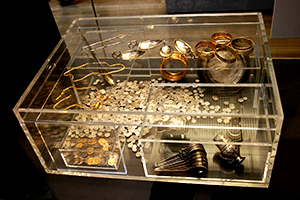
On this day, Eric Lawes, a retired gardener and amateur metal detectorist, unearthed a ‘treasure chest‘ of Roman silver and gold from the fourth and fifth centuries while helping his farmer friend, Peter Whatling, to recover a lost hammer. Having discovered some silver spoons, gold jewellery, and numerous gold and silver coins, the two men notified the Suffolk County Council and the police without attempting to dig out any more objects. Their prompt notification, allowed the remarkable hoard to be dug out in situ by professional archaeologists the following day. The Hoxne Hoard, as it came to be called, contains several rare and important objects, such as a gold chain and silver-gilt pepper-pots, many of which are on permanent display in the British Museum. Lawes received a £1.75 million reward (about £4.5 million in 2023) which he choose to share 50-50 with his farmer friend.

Reconstruction of the original ‘treasure chest’

Puoi trovare altre brevi notizie storiche QUI


Your comments are always very welcome.


American Airlines Flight 444

15th November 1979

On this day, American Airlines Flight 444, a Boeing 727 flying from Chicago to Washington, was forced to make an emergency landing at Dulles International Airport. In one of the mail bags on board the aeroplane was a pipe bomb, constructed by Ted Kaczynski, more commonly known as Unabomber. Fortunately for everyone on board, the bomb only partially detonated causing “a sucking explosion and a loss of pressure,” which was then followed by large quantities of smoke filling the passenger cabin. Twelve passengers were treated for smoke inhalation but nobody was injured. Unabomber (University and Airline Bomber) was a reclusive American mathematician and domestic terrorist. Between 1978 and 1995, he mailed or hand-delivered a series of increasingly sophisticated bombs that cumulatively killed three people and injured 23 others. By the time of his arrest, he had become the subject of the longest and most expensive investigation in the history of the Federal Bureau of Investigation.

FBI sketch of Unabomber – 1987

Puoi trovare altre brevi notizie storiche QUI


Your comments are always very welcome.